EARTH'S ATMOSPHERE (Part 2)
Structure of the Atmosphere
The atmosphere consists of almost concentric layers of air with varying density and temperature.
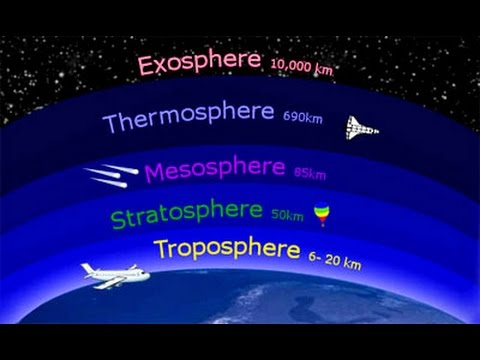
a) Troposphere:
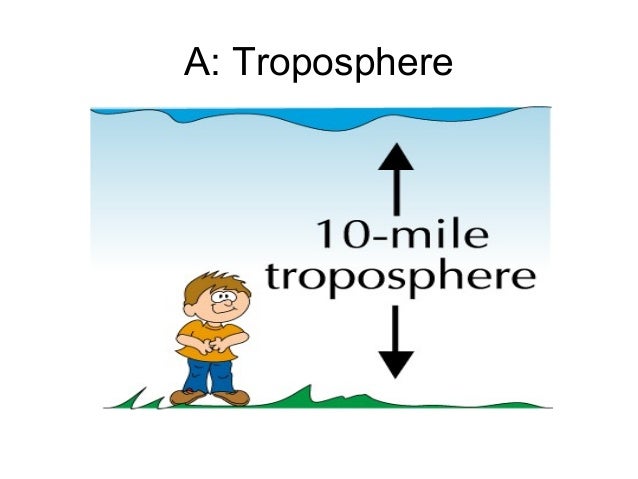 • Lowest layer of the atmosphere
• The height of troposphere is 16 km thick
over the equator and 10 km thick at the poles.
• All weather phenomena are confined to troposphere (e.g. fog, cloud, frost, rainfall, storms, etc.)
• Temperature decreases with height in this layer roughly at the rate of 6.5° per 1000 metres, which is called normal lapse rate.
• Upper limit of the troposphere is called tropopause which is about 1.5 km.
b) Stratosphere:
• The stratosphere is more or less devoid of major weather phenomenon but there is
circulation of feeble winds and cirrus cloud in the lower stratosphere.
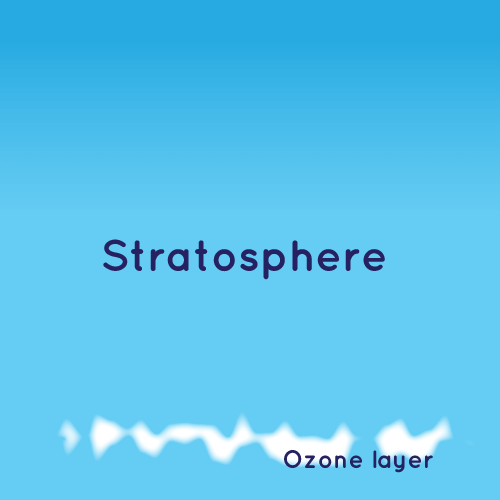 • Jet aircrafts fly through the lower stratosphere because it provides conducive flying conditions.
• Ozone layer lies within the stratosphere mostly at the altitude of 15 to 35 km above
earth's surface.
• Ozone layer acts as a protective cover as it absorbs ultra-voilet rays of solar
radiation.
• Depletion of ozone may result in rise of temperature of ground surface and lower
atmosphere.
• Temperature rises from -60°C at the base of the stratosphere to its upper boundary
as it absorbs ultra-voilet rays.
• Upper limit of the Stratosphere is called stratopause.
c) Mesosphere
 • Mesosphere extends to the height of 50- 90 km.
• Temperature decreases with height. It reaches a minimum of -80°C at an altitude
of 80-90 km
• The upper limit is called mesopause.
d) Thermosphere
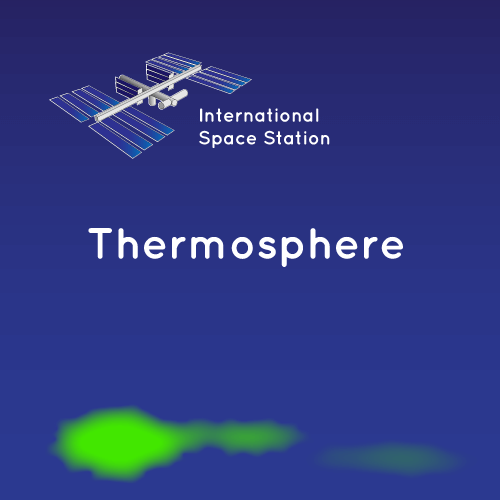 • It lies at 80 km to 640 km above the earth's surface.
• It is also known as ionosphere.
• Temperature increases rapidly with increasing height.
• It is an electrically charged layer. This layer is produced due to interaction of solar radiation and the chemicals present, thus disappears with the sunset.
• There are a number of layers in thermosphere e.g. D-layer, E-layer, Flayer and G-layer.
• Radio waves transmitted from earth are reflected back to the earth by these layers.
e) Exosphere
• This is the uppermost layer of the atmosphere extending beyond the ionosphere.
• The density is very low and temperature becomes 5568°C.
• This layer merges with the outer space.

No comments:
Post a Comment